Plan Your Crowdfunding Shipping Costs
Plan crowdfunding shipping costs before setting the rates your backers will pay. Start with product dimensions, packed weight, and packaging, then account for freight and last-mile fulfillment. This guide explains the main cost components and how your choice of shipping routes and fulfillment hubs affects the budget.
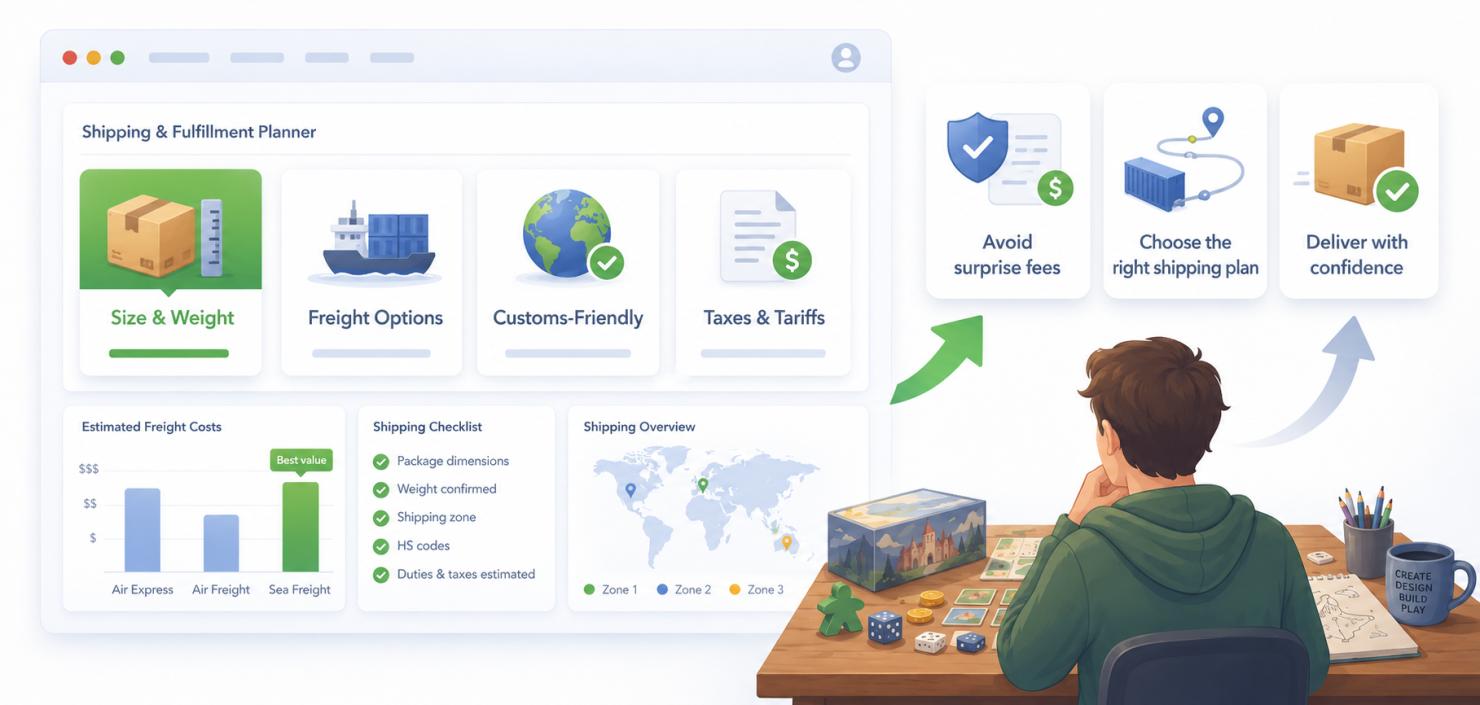
Developing a solid plan for your project's fulfillment is crucial, and while there isn't a one-size-fits-all approach, there are certain things to keep in mind:
- Determine the size and weight of your game. Knowing these factors will help you choose appropriate packaging for mailing the product to your backers. Once you have an idea of the packaging requirements, you can request quotes from shipping providers. Smaller games/products may be sent directly from China in bubble-wrap envelopes for better shipping rates, while larger products may require sea freight transport to local hubs before being shipped to backers.
- Decide on Customs-Friendly shipping. Consider which countries you will offer Customs-Friendly shipping to. With this option, backers will pay shipping costs in the pledge manager, and there will be no additional charges upon delivery. If you opt not to offer Customs-Friendly shipping for a particular country, local authorities may impose additional taxes on the package upon delivery.
Once you have a plan in place for Customs-Friendly shipping to certain countries, you can use badges or labels to inform your backers about this option. Here's an example of what the badge might look like:

Providing a Customs-Friendly solution for a certain country will require from you either to prepay custom and duty fees (for example if you mail directly from China to the destination country), or to first sea freight the games/products to the destination country (paying any custom and duties fees on import) and then using a local hub for the last-mile shipping.
If you find this process daunting and you need help, then for first time creators we do offer a very affordable consulting package, where we do all of these with you, helping you navigate those treacherous waters while at the same time teaching you all you need to know so that you can be ready to run things on your own in your next campaign. You can read more about this package in the article below:
https://www.hiveinteractive.net/fulfilment
Once you have planned your costs, see Configure shipping rates in Hive.
Freight Shipping and Cost Planning
If your final volume of product you need to deliver is big, then it will be more cost-effective to sea freight it from China to local hubs, and then use local fulfillment hubs for the final delivery.
Keep in mind, that when you calculate the shipping costs you want to charge your backers, you must not forget the freight costs.
You have a carious options to ship product out of China: FCL and LCL, EXW or FOB and you also need to account for Import VAT/Taxes.
1. FCL Freight: Full Container Loads
When you ship via FCL, you use a container to store all your product inside from the factory. The container travels sealed until it reaches the warehouse in the destination country. This process is faster than the LCL, and you have more control and monitoring. Also it is more cost effective.
There are 2 sizes of containers you may use. Each has a different capacity, and price:
40ft HQ Container
You can fit about 10000 games (floor-loaded, not on pallets) of size 28x28x7cm in a 40HQ container. The door-to-door cost for the container to go from the factory in China to the warehouse of the fulfillment hub is, right now (March 2024), about $8000 to $10000 USD.
This option gives you an average of about $0.8 to $1 USD per game freight cost, when the container is fully loaded.
20ft Container
You can fit about 4000 games (floor-loaded) of size 28x28x7cm in a 20ft container. The door-to-door cost for the container to go from the factory in China to the warehouse of the fulfillment hub is, right now (March 2024), about $6000 to $8000 USD.
This option gives you an average of about $1.5 to $2 USD per game freight cost, when the container is fully loaded.
Consolidating
We have a Free Consolidation service. With this service we give you the chance to ship along with other creators that are shipping at a similar time as you, consolidating your cargo in containers.
The goal here is to try and fill the containers with as many games/products as possible and thus saving you thousands of dollars in freight costs! You can read more about it here:
https://www.hiveinteractive.net/freight-consolidation
2. LCL Freight: Pallet Shipments
If you do not have enough volume to ship using a container, and/or you can not wait for a consolidation solution, then you will need to ship your product in pallets.
Shipping in pallets takes longer, it is more expensive, and there is a higher chance of unexpected delays. The reason behind this is that everything that is loaded on a boat, is loaded in containers. Even when you ship as LCL, the freight company will consolidate your cargo with other of their customers. They will loaded as pallets in containers and ship it out.
This also means that in the same container you may have:
- different types of products (and as such maybe different regulations for each one of them, increasing the chance of a random customs inspection)
- different final destinations. In the same container, you may have 5 pallets, and then someone else may have 3 that need to be unloaded in a destination "on the way", and someone else may have another 3 that goes to the same port as you, but different warehouses. All these mean that the container will have to make several stops, where it needs to be unloaded, processed and then continue its journey.
You need to be aware of these possibilities, and account for them.
Last but not least, the cost per pallet can be anywhere from $600 to $1500 USD per pallet, depending on the number of pallets and the destination country. Each pallet can fit about 280 games of size 28x28x7cm, which means that your final estimated cost per game can be from $2.1 to $5.5 USD!
3. EXW vs FOB
When booking a shipment from one country to another, it's essential to be 100% sure you know the Incoterms for the shipment. These can be either EXW or FOB. EXW stands for Ex Works, while FOB stands for Free On Board.
In practice, the Incoterms of your shipment dictate who pays the local expenses at the departure port. For example, if you are shipping out of China and the shipment is EXW, then your forwarder will have to pick up the product from your factory, transfer it, and load it onto the boat, paying all associated fees.
If the shipment is FOB, then the factory is responsible for all the fees associated with loading the product onto the boat.
It's crucial to ensure that everyone involved in a shipment has agreed to the SAME terms. Any miscommunication can lead to delays, fines, and extra charges. If the factory gave you a manufacturing quote for EXW, then you need to inform your forwarder so that they include the extra FOB charges in their quote. By default, forwarders quote only for the sea transfer, and you need to know this information when comparing quotes.
If your factory quotes you FOB, then keep in mind that unless otherwise stated, the FOB is included for ONE destination. This means that if you produced in China and then split the cargo to the US and EU, then these are TWO destinations, and you will need to pay the FOB cost twice. Therefore, if your manufacturing quote was FOB and includes one destination, you need to be ready to pay the extra fees for the second destination. Generally speaking, when you ship to multiple destinations, it is better to get EXW prices from your factory.
4. Booking Freight
When talking with agencies to book your freight you will need to have a certain amount of information on hand. This includes:
- Cargo Ready Date. This is the date that the cargo will be ready for pick-up at the factory. Please make sure that this is accurate! If for any reason you proceed with a booking and the factory is delayed and cannot deliver on time, you may be obliged to pay "Dead Freight" fees. This essentially means that you will still pay the freight cost even if you do not ship anything out!
- Pickup Information. You will need to know the full address AND contact information (name, phone number). The local agent will need to communicate with the factory/warehouse for the pickup.
- Delivery Information. You will need to know the full address AND contact information (name, phone number). The local agent will need to communicate with the recipient for the pickup. You will also need to specify whether the delivery address is Residential or Commercial. And whether there is an unloading ramp or the truck needs to have a tailgate.
- Importer of Goods (Consignee). On all official documents the factory needs to put the Consignee's information. This is the company that will be responsible to import the goods at the destination country. You will also need a local Customs Agent to help you with the paperwork at the destination's customs. We (Hive) have subsidiaries in US, EU and Canada, and we can help you by acting out as your importer.
- Commercial Invoice. This is an invoice issued by the factory (Shipper) and mentions the Consignee. In this invoice the goods need to be described. In the case of Board Games, please make sure to have the correct HTS Code (9504.90.6000) clearly stated on the Invoice, as well as the "Country of Origin" (should be "China")
- Packing List. This is also issued by the factory. It should continue accurate Weight and Volume for the cargo. Please be careful, some times factories give estimates instead of accurate information. When the booking is done using estimates and then the cargo ends up having different weight and volume than the one initially reported, you will be hit with surprise extra fees.
We can provide you with a quote for transferring your goods from China to any hub around the globe. Do not hesitate to contact us.
5. Comparing Quotes
It is always good to shop around and get quotes from different factories and freight forwarders. During this process please make sure that when you gather the information and you start comparing it, all the quotes are about the same shipment parameters.
You need to make sure that all of the items below are the same for each quote:
- If you ship FCL, whether the cargo is floor loaded or on pallets. If it is floor loaded ask the palletization cost at the destination. Items will not be stored in a warehouse without them first being put on pallets.
- If you ship LCL, make sure the volume (CBM) and weight (KG) of each pallet is the same across all quotes.
- Make sure that all quotes are either EXW or FOB. Do not try to compare EXW quotes with FOB ones.
- Make sure to clarify whether the local expenses at the destination are included or not. Forwarders tend to quote only the "boat fees". If someone gives you a "door-to-door" quote this may be a way more safe option than trying to piece the fee puzzle yourself.
Here is a break down of all possible fees associated with a freight from China to EU or US:
- Local expenses in China. If your manufacturing quote is FOB, those are included, if not you will have to pay them as part of your freight costs.
- Freight. This is the actual cost of only the boat transfer.
- Customs Processing at destination. A customs broker will need to do paperwork at the destination to clear the cargo. There are flat fees per container that need to be paid, but there are also Taxes/Vat/Duties that are based on the total commercial invoice's value.
- Local expenses at destination. This includes the transfer of the container from the port to the hub. When you ask a freight quote, they may not include this cost!
- Unforeseen / adhoc expenses. International freight is very volatile and subject to things that are out of your control. These include: random inspections from customs officers (in US it can be $300 per day plus a $1500 government fee for the inspection!), strikes (yes it can happen, and the cost can be $300 per day that the container is not released!), changes in the trip because of a disaster (e.g. Baltimore bridge went down, a port closed due to strikes, a war erupted, Suez canal was blocked, etc)
Import VAT, Taxes and Tariffs
The freight costs you will receive usually include import services, EXW, local expenses in China and destination countries. But they do NOT include:
- local warehouse receiving fees. These you need to discuss with your hub.
- Import VAT/Tax or Tariffs, as these depend on the destination country and the Commercial Invoice's value.
EU VAT
For the EU, the VAT is anywhere from 20% to 25% on the total value of the Commercial Invoice plus the freight cost. For UK it is 20% on the total value of the Commercial Invoice plus the freight cost. If you do not have a business in the EU and the UK you will need to collaborate with either a local partner, or hire an accountant to setup OSS for you (https://vat-one-stop-shop.ec.europa.eu/index_en).
If you need help navigating EU/UK VAT do not hesitate to contact us.
US Tariffs
As of Aug 2025, the tariffs on imported goods from China have changed, and at the time of this article, the tariff rate is 30% on the manufacturing cost of goods. Here are key considerations to ensure everything is handled correctly:
1. Tariffs are Based on Manufacturing Costs
When shipping goods via freight, tariffs are paid on the manufacturing cost at US customs when the shipment arrives. The manufacturing cost is detailed on the Commercial Invoice provided by your factory, which will accompany your goods. Note: Tariffs are not applied to the retail price of your product.
2. Ensure the Invoice Only Includes Manufacturing Costs
It’s essential to confirm with your factory that only manufacturing costs are included in the invoice. Many factories might include service costs in the invoice that should not be counted towards the tariff. For example:
- Design services (e.g., designing a plastic tray) should not be included. If your factory designs the tray, it’s a service you could have sourced elsewhere.
- Similarly, costs for services like e-proofs or shipping prototypes should not be included, as tariffs are not applied to services.
3. Exclude Mold and Tooling Costs
Make sure the invoice does not include any mold or tooling costs. These are costs for items (like molds for minis or punchboard tokens) that stay in China and are not shipped to the US. Since these items don’t travel with the shipment, they should not be included in your invoice for tariff purposes. If you later request your factory to ship the molds to the US, then tariffs will be applied to their cost at that time.
4. Estimating Your Tariff Costs
Typically, production costs (including tools, services, molds, etc.) for a Kickstarter campaign are about 20% to 25% of the retail pledge price. By separating services from manufacturing costs, your invoice should reflect around 10% to 15% of the retail price. This means you can ask US backers to pay 6% to 9% in taxes/ tariffs, which should be sufficient to cover the tariff costs.
This percentage is also less than what EU backers pay as VAT or about as much as the state sales tax in the US, making it a reasonable and manageable amount.
If you are looking for instructions on how to set VAT and Tariffs in your account, then read this article.
Unforeseen Expenses
Last but not least, the estimated costs does not include unforeseen/unscheduled charges. Examples of such charges are: random customs inspection (this can be $150 to $1000 per container), delays in the delivery of the container (companies give you 3 days for free to get the container from the port, unload it and bring it back, if the warehouse doesn't have a slot to take it in soon you may be charged demurrage fees at a rate of $50 to $300 per day).
Fulfillment Hubs and Last-Mile Shipping Costs
There are many fulfillment hubs out there that can help you deliver your product to your backers. Usually the best solution is not to use one for all countries, but rather use multiple hubs for different territories.
Here are some that we have worked in the past with:
- US: Bridge, Quarter Master Logistics (QML), Fulfillrite.
- Canada: Pick & Pack.
- EU: Happyshops, Green Logistics, GamesQuest.
- UK: Zatu, GamesQuest.
- Asia: VFI.
- Australia: Aetherworks
Before shopping around and start getting quotes, make sure you know the approximate size and weight of your products. This is very important! Mistakes at this stage can cost you thousands of dollars in unforeseen shipping costs.
When receiving a quote from a fulfillment hub make sure that the prices you get are the final ones. Hubs usually give you an excel sheet with costs per weight per destination for your packages, but these are the shipping costs rates for the local courier company (e.g. FedEx, DHL, USPS etc). They are not the costs you will have to pay.
The final cost for each package must include the following:
- Courier Shipping Rate. This is the cost per KG (or LBS) per destination (country or state/province).
- Materials. These costs include the carton and bubble-wrap or other packing materials used.
- Per Order. This is usually the labor cost each hub charges per order they have to pack/handle for you. It may or may not include some picking fees (read below).
- Picking Fees. For each item the hub needs to put in the package they send to your backer, there may be an extra charge. Some hubs include in their "per order" fee anywhere from 1 to 5 pick for free, and only charge you for extras. Others may charge from the first one.
- Seasonal Fees. If you are shipping in high season (e.g. during Christmas), then there may extra seasonal fees that need to be applied.
Make sure that you ASK each hub you are receiving a quote from, enough questions to clarify ALL of the above costs, or you risk not being able to accurately compare quotes, and make grave mistakes in the process.
Product Packaging and Shipping Dimensions
In general the dimensions of most items that you will be packing are known and/or easy to figure out. If it is box it is the dimensions of the box. That simple.
But, there are cases where things get a little bit more complicated when trying to distinguish between the actual dimensions and the dimensions the item will have when packed. Below you will see two usual cases of such items, that require special attention.
1. Ziplock Bags
We begin with the ziplock bag. Its dimensions are not an easy to define. In this case there are two different approaches:
- Either assume the ziplock bag is placed flat in the box during packing. This means that width and length will match the ziplock bag, but height will be the height of its contents.
- Or assume that the ziplock bag has more length than content, and as such the packer will roll it, and then place it in the packing box. In this case it will have the width of the ziplock bag, the height of its contents and the length of whatever length the final rolled item will have.
Unless you have the final ziplock bag with its contents in your hands, this is not something you can figure out exactly.
Generally speaking a good approach is to go with (1). Unless you have really big ziplock bags, this should not affect shipping costs.
2. Game Mats
Similar to Ziplock Bags, the game mats can be packed in different ways. But, they are also way heavier, which means that they will definitely play a big role in the final shipping cost. Also they are way bigger/longer/wider than a ziplock bag, so how you pack it greatly affects the dimensional weight of the game mat, which in turn affects shipping.
For game mats, you have three options:
- Ship it flat. This will definitely hit the dimensional weight and it may end up having really high shipping costs. You should avoid it.
- Ship it rolled. Depending on the size of the game mat this could be a good option. The final dimensions will be based on the rolled mat, and you should be able to fit it in your shipping box nicely.
- Ship it folded. If your game mat is really big and both dimensions are almost equal (for example if you have a game mat that it is 48x48cm), then shipping it rolled will still incur really high costs due to dimensional weight. In this case you may need to consider shipping it folded, instead of rolled. A folded game mat of size 48x48, should become 24x24 with a height of about 4 or 5 cm (do not "Squeeze" it). It may sound unconventional, and you may be wondering if that will damage the game mat. Based on our experience, and depending on the quality of your game mat, you should not have a problem shipping it like that. A backer can lay it flat on a surface for half a day and the game mat will be as good as new. You can test that theory by having your manufacturer send you a game mat sample like that from their factory.
Dimensional Weight and Shipping Costs
Last, but definitely NOT least, you need to be aware of the concept of dimensional weight. When the hubs quote you by weight, then that weight is the higher between:
- the actual weight of the final package
- the dimensional weight of the final package. This is also known as volumetric weight, and it's a measure of weight estimated from length, width and height. Each courier company establishes it according to a slightly different guideline.
For example, a package with dimensions 28x28x10cm has a dimensional weight of 2KG. This means that if your game/product is lighter than that, the companies will charge it as if it was 2KG.
There are many dimensional weight calculators you can find if you Google. Here is one for your convenience:
https://www.omnicalculator.com/other/dimensional-weight
Please make sure you use the correct weight when trying to estimate your game's shipping costs. The hubs will NOT do that for you.
Product Size, Cartons and Freight Volume
1. Product Size
Deciding the right size for your product affects all parts of the fulfillment process. Many creators do not figure this out until it is too late. A slight difference in the size of your product may result is extremely lower (or higher) freight and shipping cots!
In the case below we will use as a baseline a usual size for a board game, which is 28x28x7cm. This is packaged a carton of size 30x30x45cm, which will hold 6 games inside.
Freight Cost Implications
Transferring items from China to US, the pallets used are of type "industrial", and this allows the factory to tweak their size to fit your cartons. They can be about 110x110cm but there is no standard size. They can change them to 100x120cm with no extra costs or fees.
But, transferring items to EU, they have to be on euro-pallets, and they have a standard size of 120x80cm.
Using the board game above. In EU you can place the above cartons in such a way where the floor of the pallet has 4 cartons lying with their 30x45cm sides, and next to them 4 cartons standing on their 30x30cm sides. This allows you to cover 120x75cm of the 120x80cm of the euro-pallet, taking advantage of almost all available volume, which is 94% of the available volume.
But what happens if we change the box size to 30x30x8cm? This will require a carton of 32x32x50cm. Trying to fit those cartons on the pallet, the best you can do is two cartons 4 cartons lying on their 32x32cm sides, and 2 on their 50x32cm sides. This allows you to cover 114x64cm of the 120x80cm, which is 76% of the available volume. As you can understand you are now paying 24% of your freight costs to literally move empty air space!
Use our awesome tool CBM Calculator to experiment with different sizes of cartons so that you can see what works best for your project. This is an invaluable tool that can save you thousands of dollars in wasted freight fees!
Last Mile Cost Implications
Your product will need to be added in cartons. In the US, regular sizes for cartons are in inches, and they follow a pattern of 6', 8', 10', 12', 14' etc. So, you have a bigger variety of choices of shipping cartons (which translates into lower costs) if your final product size fits into regular shipping cartons. If it doesn't the hub will either have to order custom made cartons for your projects and/or charge you extra labor cost for packing.
2. Carton Marks
To transfer your product from the factory to the hubs, it will have to be placed inside cartons. Each carton will hold a number of items of the same SKU.
When creating your cartons, as a best practice please make sure that you print on each carton the information below:
- Company Name (this should be your company's name not the factory's)
- Weight and Dimensions of the Carton
- SKU, Item Description and Barcode of the item inside the carton
- Number of items inside the carton
Having the above on the carton will greatly help loading/unloading and processing of cargo at the fulfillment hubs, making the entire process run smoother.
Plan Batch Fulfillment
If you need to fulfill your backers in batches (for example you want to send now the ones that paid premium to get it first and a month earlier than the rest, and then ship the rest later), then our system can help you manage this process with the right rools.
For the full process, see Fulfill crowdfunding pledges in batches.